
with Xaris Symvoulidis
I still remember Lüüp’s magnificent debut Distress Signal Code (2008), where you made a guest appearance. Since then, we’ve been hoping for a live collaboration between you and Stelios Romaliadis here in Athens — and now this will finally happen during the upcoming Ostomachion Sessions (24/4), with Romaliadis and George Varoutas.
But why now and not earlier?
That’s a good question! Really this is a long overdue musical reunion with Stelios – although I did see him relatively recently at the Chris Stassinopoulos Band gig @ The Megaron (23/2/19). I was there with with David Cross, where DC and I also did a Duo improvised set.
I’m always busy and flitting about from intriguing and tempting musical projects. I get exciting musical propositions – and try and fit in as many as I can. I love the challenge of new music and collaborations – and it’s always a bonus if there’s travels and meeting up – which I love. And I know that Stelios has been finding wonderful new partners and fascinating collaborations and forging his own solid and fascinating path forwards.
Really the simple answer is ‘GOLDEN OPPORTUNITY! I see this forthcoming Ostamachion gig with Stelios and George Varoutas as the perfect occasion to leap forward as a duo – or rather a duo plus ‘Factor X’. The Lüüp sessions were just the two of us and an invisible engineer. The tape machines were our Factor X back then. But Stelios drew me there with some delightful musical themes, which are now haunting me once again!
I was initially inspired by the young Stelios’ beautiful flute playing – which is where I myself started out about 70 year ago now. He had then a cool new plan for us two to create something special and unique – and I’m sure it will happen once again in the inspirational city of Athens – with the help of George Varoutas!
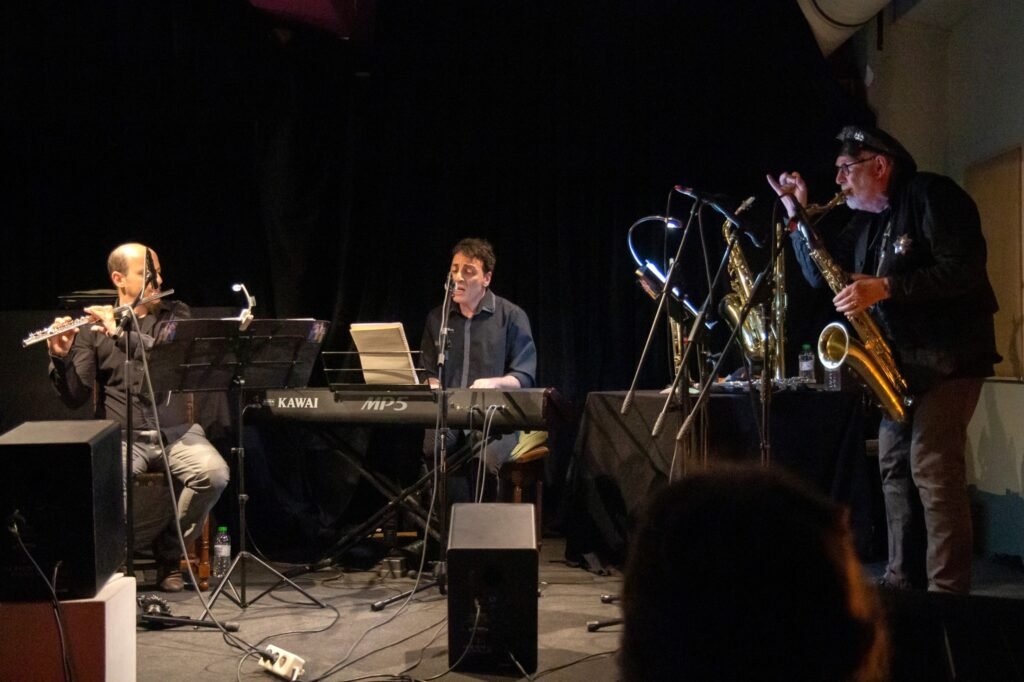
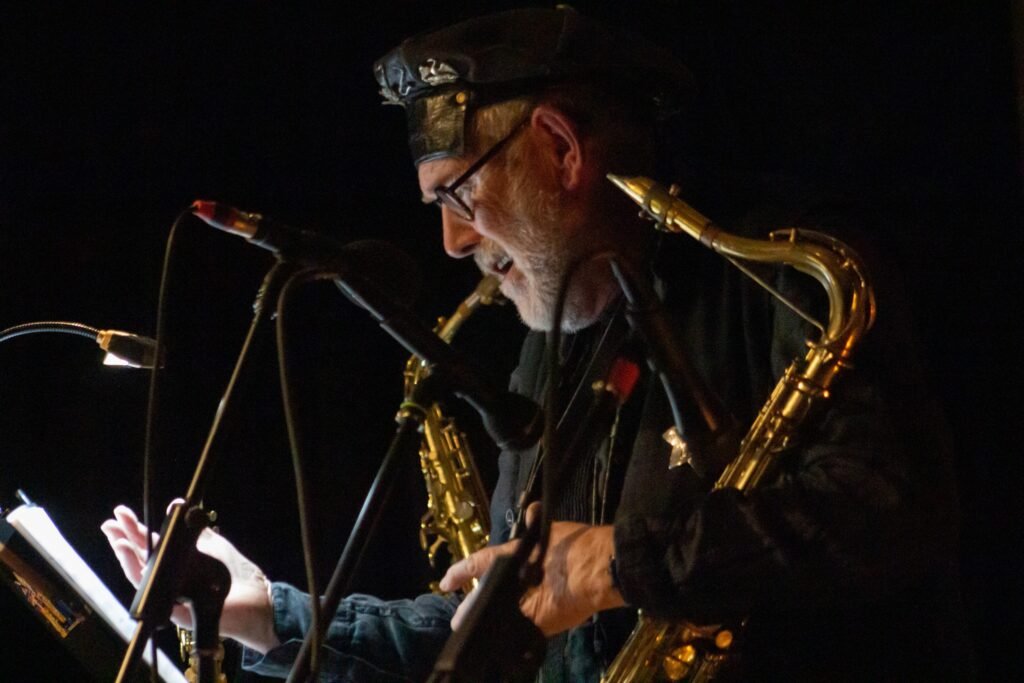
What is it about you and Italy? Speaking of joint projects with other musicians, I’ve noticed that you have an impressive catalogue of Italian collaborations. Is this special connection due to the wild situations you experienced there with Van der Graaf Generator, during the 1970s? Or does it have to do with a personal affinity for the Italian progressive rock scene?
Italy: well! Van der Graaf Generator had a Number 1 record in 1972 with George Martin’s anthem ‘Theme One’. (17 weeks at No. 1!). That is a life changing event! It’s an instrumental and I got photos with my saxophones in every magazine – and a lot of front pages too. I could step out of a car at 7am and someone would shout ‘Oi Jaxon!’. Perhaps I shouldn’t have worn my famous leather hat all the time: but it was – and still is my lucky talisman – and is always practical and comfortable!
Il Gobbo! When I first played in Rome with VdGG at the famous Piper Club in 1972, I was exploring the neighbourhood and spotted a beautiful church. Some young VdGG fans in the street spotted me and shouted ‘Oi Jaxon, Jaxon’! Then one young guy patted me on the back in a friendly way – and then pointed up to a gargoyle on the top of the wall. ‘Look there is ‘Il Gobbo’ – the lucky hunchback. It is good luck to touch if you can reach it.’ I already had a bent spine due to childhood Scheuermann’s disease. I added heavy saxophones round my neck for hours on end, so I my back soon became more and more ‘Gobbo-esk’. So, I apparently bring good luck to Italians? Well it’s reciprocal – they always bring me wonderful friendships and music; thrilling gigs; and not to mention the fine dining!
Unlike the often feared or pitied hunchback figures in other cultures, the Italian ‘Il Gobbo’ is a cheerful, dapper character who represents a powerful good luck charm, apparently, believed to transform misfortune into laughter and luck!
And there is also the Cornicello myth – Italy’s Red Horn of Fortune! With my Double Horns (two Saxes at once) I must be a triple whammy for Italian good luck. So I’m still a bit of a ‘mito’ in Italy. (Mito means myth or legend in Italian.)
So maybe a few Italian bands have asked me to collaborate over the last 54 years (the current count being possibly 34!) But there have been a few other other counties calling me in too, especially if you add in my Soundbeam Projects:- Ireland (Special Olympics 2003), Holland (René van Commenée), Germany (Bethel), Sweden (Aranäsgymnasiet 2008), Norway (Grieg Academy), Armenia (Mikayel Abazyan) and of course Bosco Profundo in Italy!
For many music lovers, your name is still closely associated with Van der Graaf Generator—and from various interviews we get a glimpse of the amazing days you shared together.
How did such a closely interdependent team manage the pressures, which must have been enormous at times?
The four key and longest serving members of Van der Graaf Generator were Peter Hammill, Hugh Banton, Guy Evans and me, David Jackson. We were great friends and we had a lot of fun together in every part of the life of a rock band: writing music, rehearsals, recording sessions, travelling – and of course the best bit, gigs. We often wondered how we managed for so long. We sometimes thought that it may have been our birth signs: Scorpio (PH), a Taurus (HB), a Gemini (GE) and an Aries (DJ) – Earth, Air, Fire and Water – the perfect cosmic balance? Somehow we were a pretty balanced team, all having complementary skills and interests that kept us in pretty good humour and harmony over the years. Obviously we had crew, but for many years it was essentially the four of us creating the music together and travelling in a really nice car: and I loved to do most of the driving, which they may have preferred!
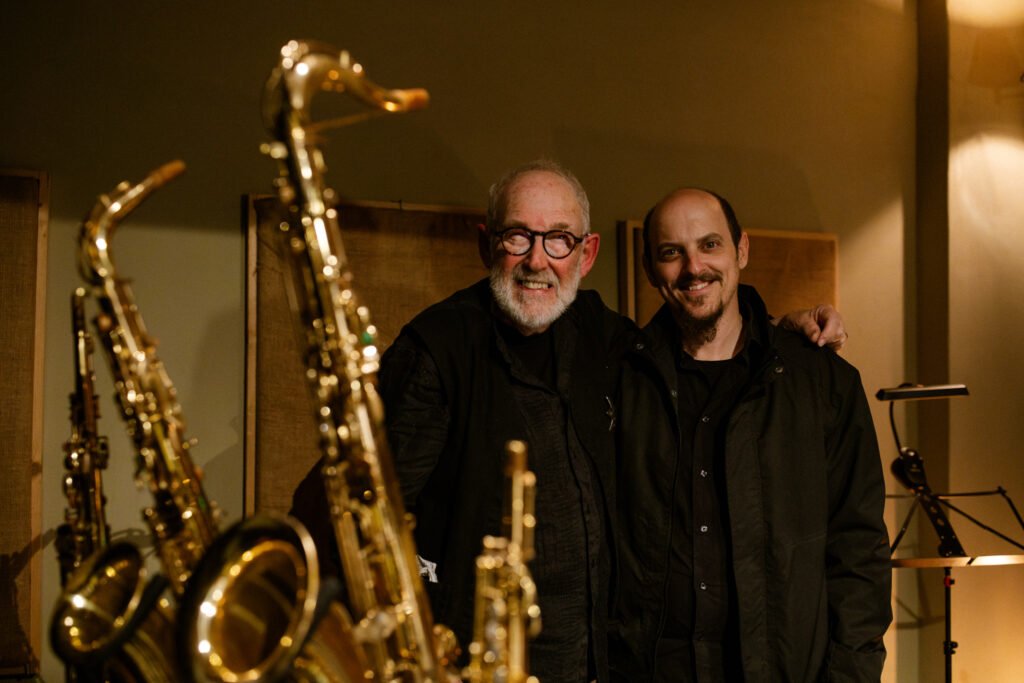
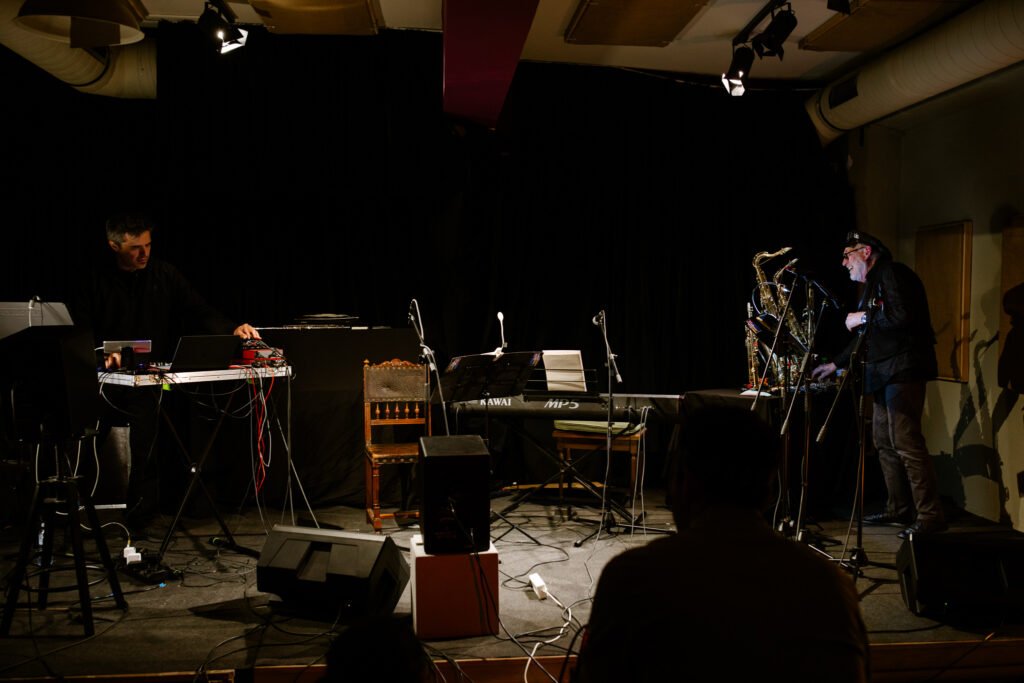
So, what should we expect from the Athens Ostomachion Sessions? What will be the main creative challenge in the interplay between acoustic and digital instruments?
Well, I’ve always loved improvisation, which started with my very first instrument – a flute made of bamboo at the age of about 5. I suppose I called it ‘making up tunes’. I stared with the nursery tunes, like early singing – and then extended them. The secret was to find somewhere new where the actual acoustics space made a difference – and made my sound fresh and spontaneous. It could a mirror in a corner, a bathroom, a hall, under the stairs, or even outside in a courtyard – or even in a quarry.
With the advent of modern music technology, definitely not available to me until VdGG, the creation of infinite sonic adornments has re-inspired me over and over again: reverb, echo, flange, fuzz, wah-wah, octave dividers etc. etc. I still have many bits of magic music technology that I’m not prepared to give up on . . . yet!
But what is even more important is the inter-personal exchange – action and re-action in live musical collaboration, especially in improvisation. The essence of live music is reacting to all of these elements and and the environment. And of you must never forget the vital audience as the inevitable key variable in providing extra energy into the musical equation.
I know that Stelios Romaliadis is an inspiring musician to play with. I have seen on film the astonishing work of George Varoutas and know that his instinctive reaction to us will cause us to re-engage and create totally unique, unrepeatable and memorable musical moments and events at The Ostomachion Sessions.
Looking back at festivals like Reading 1979, how different did the live music environment feel compared to today? Among the promo material for the Ostomachion Sessions, we received a photo of you with Peter Gabriel from the Reading Festival in 1979.
Well, that is really interesting and just a bit topical! There is a link below to a film I made recently with Jim Christopulos all about that Peter Gabriel period in 1979. JC is of Greek extract, lives in Chicago and is the author of VdGG The Book.
The music environment for ‘Rock Music’ particularly in the 1970s was exceptional. Firstly the many genres that we now take for granted had not even evolved, or been diagnosed. We had Pop, Rock & Blues. There were just a few great Radio stations and music papers that had a massive circulation and following. This meant that what was happening in music held people’s attention. (There are now over 100 to 150 recognised sub-genres and fusion genres of rock music, so it is not the same anymore.) I think we now call what we did back then Progressive Rock?
It was a time when bad things happened internationally and the government, or the media, didn’t quite know how to handle or re-act appropriately to them. Rock musicians were not so timid. Here’s a few examples: Live Aid, Bob Geldof 1985; Lou Reed’s ‘Perfect Day’ 1997; Sir Elton John AIDS 1992/3 etc. But it was Peter Gabriel who made a profound intervention with the Biko story at the Reading Festival in 1979 with his newly written song Biko. And I was involved!
The band hit that massive Festival stage at dusk with a brand new and completely unknown song. We had literally just learned it from PG in rehearsal. He chanted ‘Biko’ endlessly and everyone knew and felt the outrage. The audience understood, immediately felt the mood and had to join in. I remember the crowd chanting and shouting and the people clapping on the perimeter fence silhouetted by the sunset! With the massive delay on the Festival PA, that clapping was staggered as it went out from the stage – and it felt like waves!
Did you learn its spirit more from the jazz masters or from the rich traditions of folk music? Improvisation seems to play a central role in your musical language. Is it true that it constantly keeps you on the edge of creativity?
Well, I stared out really young (5) teaching myself nursery tune and making up variations on wooden flutes. From aged 7, I learned piano and flute at my boarding school, but my biggest duty was singing as Head Chorister and soloist in the school Choir, until I was 171⁄2. (A hormone deficiency issue plagued me as a teenager – which was an extra burden, made worse by Matron who marshalled her ‘no clothes allowed rule’ with the back of a hairbrush!)
In the holidays, I had my big brother Michael who played clarinet and then saxophones – exceptionally well. He was classically trained, but knew loads of Jazz standards and particularly loved BeBop. He gave me his old and battered Alto sax and the basic techniques – and we started out with ‘Throckmorton The Plumber’, by Charle Parker. At the same school I played in a Trad Jazz Band, a Blues Band and a Georgie Fame tribute band. I also played loads of gigs with Michael’s Dance Band in Wales during University holidays. In all these bands we improvised to survive!
But you can never underestimate the hundreds of hours I spent listening and practicing. At both school and university there was time and space. Jazz was a defiance to the strict classical music tradition that plagued my school life. And there were masters of the art of improvisation to whom I was devoted, whether on Radio or on vinyl:- Paul Desmond, Rahsaan Roland Kirk, Cannonball Adderley, Sonny Rollins, John Coltrane and Bobby Wellins, Paul Horn, to name just a few.
When I was younger, I was not so much aware of, or drawn towards Folk music, but in recent years that has definitely changed. I have worked with Tim Edey who turned a few keys for me. I have learned many reels and jigs and practice them as finger and breathing tonics!
I am also greatly attracted to storytelling in music. There were always great words and stories in Van der Graaf Generator songs. Kaprekar’s Constant definitely re-awakened that interest in me. One of my most recent favourite discoveries is ‘Quercus’ – which has all the right ingredients and a stunning and unique musical atmosphere.
What are the most common musical discussions you have within such a music and sound-oriented family? You have two children and a grandson.
Well, the first thing is usually ‘what have you been up to recently’ – and the answers are always impressive! Jake Jackson, my son, is a recording engineer and producer who works at Air Studios, set up by George Martin, (VdGG’s Theme One!) He works a lot on film scores and on top level video games soundscapes. He has done a lot of work with Nick Cave and countless well known artists too. He produced my album ‘Another Day’ (2018) with David Cross and recently ‘Four Northern Songs’ with Sir Thomas Allen, the famous baritone. Jake was a brilliant Euphonium player, but he has recently taken up the Guitar, acoustic and electric. We have had several family jams which is a great new kind of family fun.
Dorie Jackson, my daughter is a brilliant singer and song writer. We have worked together in Kaprekar’s Constant (a Prog Band) and are now we’re working on her 3rd solo album after ‘The Courting Ground’ (2007) and ‘Stupid Says Run’ (2025). We gig with The Dorie Jackson Band and travel a lot together. She is a brilliant driver too!
Recent discussions with Dorie involve what she wants to do with my over enthusiastic contributions to her new songs: that I work on in my home studio. Dorie’s husband is the genius jazz pianist Jim Watson, who has contributed with Dorie to the ‘Four Northern Songs’. Jim is gigging with all sorts of British jazz and rock legends that connect with my past lives, which is always promoting interesting meetings and memories. For example, Jim Mullen (Guitar) who filled in a few missing links about the life and times of my brilliant young friend Robbie McIntosh (RIP). He became the Average White Band’s drummer sometime after Robbie and I had worked in Scotland in 1967, playing in various Blues and Pop Bands.
My grandson Herbie (14) is currently into Rap and Grunge – and Gangsta Rap and West Coast. He plays only vinyl with headphones on – out of respect for his younger step sisters who would be offended by the bad language. When I pick him up, Herbie is the DJ with my car radio – and I am getting an education, to say the least!
What lies ahead for you, after the Athens concert? And what about the (near) future?
Well, there are loads more sessions waiting for me on my computer when I get home:- a new collaborative album with Don Falcone from San Francisco – nearly finished; the latest album from ‘Ellesmere’ (Rome); a new album with ‘ReAgente 6’ (amazing Italian music in the Joe Zawinul tradition); and loads more Dorie Jackson songs to record – and many gigs in the pipe line for her brilliant multi- generational band.
Another highlight after ‘Ostamachion’ this year is ‘The Teramo Festival’ in July. I am re-uniting with the Neapolitan legends ‘Osanna’, with whom I have played and recorded with since 2008. We have played together in Japan, North Korea, Mexico and in Italy many times, of course!
Another highly significant project for me is the symphonic and choir recording of my epic Song Cycle called Beam Machine *Star Messenger 2989*. My fantastical science fiction story will have a wonderful new narration written and performed by Judge Smith. It will be recorded by Norwegian musicians under the directorship of Ricardo Odriozola. (It is a Crowd Funding Project.)
Thank you for the ‘Athinorama Interview’ Xaris Symvoulidis! The questions have been atypical, interesting and most thought provoking!
David Jackson, April 2026, Suffolk, England