
FOUR NORTHERN SONGS – Four completely new songs by David Jackson & Alan O’Cain featuring Sir Thomas Allen will be released soon!
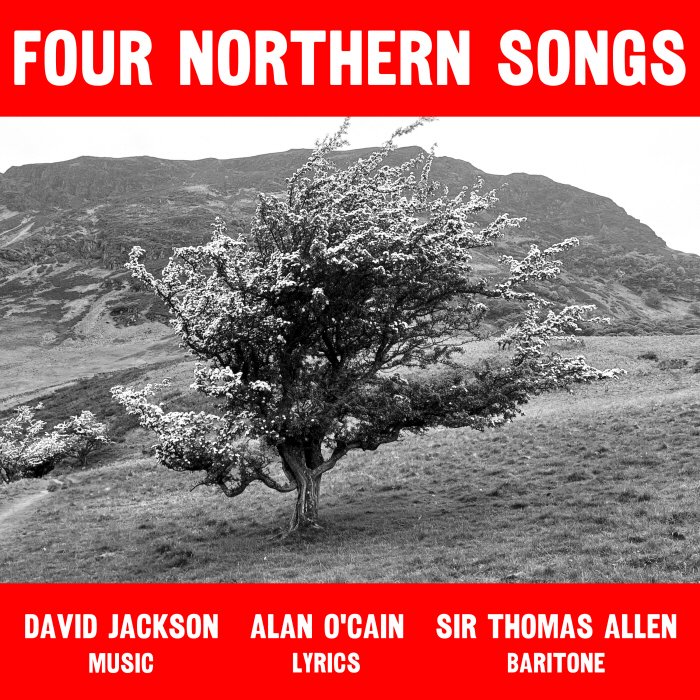
‘Four Northern Songs’ – featuring Sir Thomas Allen, created by David Jackson and Alan O’Cain
David Jackson and Alan O’Cain have collaborated to write 4 completely new songs for ‘Sir Thomas Allen’ – the very very famous classical baritone – who is now 82.
Alan O’Cain is an old northern friend of Sir Thomas Allen. Alan is is a visual artist who is turning more to poetry as his eyesight fails. The first poem was inspired by an old tune of David’s. They have previously worked together performing a ‘son et lumière’ about Edvard Munch called ‘The Endless Scream’. That first song went on to inspire three more. This suite of ‘Four Northern Songs’ would make an astonishing EP of about 20 minutes music – and attract attention from fans of very diverse genres of music.
The Songs:
The May Tree and The Pine (3:56)
My Wild Rose (6:47)
Come By (4:13)
Northern Lights (4:35)
The Musicians:
Sir Thomas Allen
Alan O’Cain – the poems
David Jackson – saxes and keys
Jim Watson – keys
Nick Jefferson – bass
Dorie Jackson – voice
Produced by Jake Jackson from Air Studios, London
A review by Ricardo Odriozola – professor of violin at The Grieg Academy, Norway. ‘They are among the most beautiful things I have heard in a very long time. I have always had a soft spot for the English Pastoral style (Vaugham Williams, Holst and others). David Jackson’s “Resolution” remains one of my very favourite pieces of music ever. How wonderful that he has turned it into a song! The music is lovely and everyone involved makes a masterful contribution. I think this is the (or one) correct way to approach the meeting of musical worlds. The integrity of all is not only preserved but also enhanced. They have all managed to create something that is both new and timeless, firmly rooted in Music – not merely “tradition” – and that is representing a blend of approaches that come together into a tasteful entity that is even more satisfying than its individual components. In a fair world, these recordings should become classics: an example of how to build and cross a bridge between seemingly disparate musical expressions.’